Inhae @Inhae

Inhae @Inhae@social.inhae.blog · 18:35

Playing Genshin in Chinese, I find that the World Quests are by far the most difficult content for me. First it’s not voiced, and then it introduces a lot of concepts and lore related to the region. I really want to understand all Natlan lore in Chinese only, so I’ll do my best to study 5.x world quests and not switch back to English.

I’ll post my study notes here, it’s a good motivation for me, and I can consult vocab easily when needed!

It’s all going to be under CW, but if you want to filter it out, I’ll use

Replies 8Favourites 2 · edited
Inhae @Inhae@social.inhae.blog · 18:38
Genshin WQ/event “Avant-Garde Graffiti Visionary!” Chinese vocab + spoilers + long

Avant-Garde Graffiti Visionary! Study session :meow_read2:

前卫: qiánwèi: avant-garde
先锋: xiānfēng: pioneer, vanguard
涂鸦: túyā: graffiti

The NPC calls herself 炫彩呆子 xuàncǎi dāizi, and I have no idea how to translate that… the idiot who dazzles colours? I’ll just call her Xuancai Daizi then.

舞姿: wǔzī: dancer’s posture and movement
律动: lǜdòng: rhythm, to move rhythmically
跳脱: tiàotuō: to break free, to move beyond, to transcend. (She’s talking about the music which transcends the rhythm, or breaks free from [classic] rhythms?)

The graffitis are described as 色彩鲜明 sècǎi xiānmíng: brigh coloured.

Xuancai Daizi is the 中流砥柱 zhōngliúdǐzhù (cornerstone, pillar) of the 「涂鸦联盟」 túyā liánméng “the graffiti union”.

After some eloquent discourse on avant-garde art, to which Paimon replies that it’s “好难懂”, she says that she participated in drawing the art behind the stage. 绘制 huìzhì means “draw up”.

If I understood correctly, she says that a realistic landscape painting (风景画 fēngjǐnghuà), Fontaine’s oil pointing (油画 yóuhuà) or Sumeru’s mural painting (壁画 bìhuà) would lack the energy that gives more zeal to the dance and music (or something along those lines…).
Paimon uses two words, which I think are key to understand Natlan art: 夸张 kuāzhāng (exaggerated) and 劲头 jìntóu (zeal, energy, vigour).

Xuancai Daizi also says that every Natlanian has a tendency to move forward.

As for the event, all we need to do is to “have an insight into” (洞察 dòngchá) the “essence” (精髓 jīngsuǐ) of Natlan’s avant-garde art, and we’ll get rewards. Nice! :blob_owo:

She says that to make graffitis, it’s more important to find inspiration than to practise drawing? We need to find the criterion (准绳 zhǔnshéng) for the concept of avant-garde? In other words:

总之要找到超脱拘束的灵感,并将其自由自在地表达出来。

超脱 chāotuō: unconventional, be detached
拘束 jūshù: restrict, contrained, restrain
灵感: línggǎn: inspiration
自由自在: zìyóu zìzài: leisurely and carefree, free and unrestrained

> In short, you have to find the inspiration to transcend restrictions, and express this newly found freedom.

I won’t lie, this whole dialogue was extremely difficult. But I’m a big fan of Natlan graffiti art :meow_wow: , so it was worth the effort. I hope the other world quests of Natlan won’t be as difficult.

Replies 1Favourites 1 · edited
Inhae @Inhae@social.inhae.blog · 16:27
Genshin WQ/event “Avant-Garde Graffiti Visionary!” Additional dialogues with Dopey Dazzler.

While doing the event, we can find Dopey Dazzler in Kinich and Mualani’s regions.
She… talks a lot… :meow_pain:

I didn’t try to understand/translate everything she says, but I liked the parts about Kinich and Mualani.

First of all, she calls Kinich a 猎龙人 (liè lóng rén), a Saurian hunter. I didn’t know he was a hunter! Interesting. Dopey Dazzler seems to be eager to recruit Kinich in the association, so members have drawn graffitis in the region where he hunts to kindle his interest for the art, but he doesn’t seem to care (不在乎 bù zàihu). (Wouldn’t it be easier to ask him directly?)

She’s a fan of Ajaw’s style, which does not surprise me. And then she uses specialised vocabulary used by Fontaine artists to describe Ajaw:

饱和度特别高,它才是名副其实的炫彩!

饱和: bǎohé: be saturated
名副其实: míngfù qíshí: worthy of the name
And then 炫彩 xuàncǎi is how she calls herself in Chinese, so I guess it should be translated with “dazzler” to match her English name. Actually, looking up 炫彩 in google image gives bright, colourful and glowy colours as result.

(Where’s the Fontaine jargon in all that? Is it just the word 饱和?)

> With his high degree of (colour?) saturation, he’s what you would call a real “dazzler”??

She also thinks that Kinich’s style (打扮 dǎban: way or style of dressing) is very avant-garde.

As for Mualani, she learnt graffiti art at the association and she was able very quickly to make some decent (像模像样 xiàngmó xiàngyàng) works to decorate (装点 zhuāngdiǎn) her surfboard (冲浪板 chōnglàngbǎn).

So does this mean that she painted the shark design herself on her surfboard? That’s pretty cool!

I also found Kachina as part of this quest (the dialogue was very long, but Kachina is easy to understand), I’ll have to look for Kinich and Mualani, and then do the closing dialogue. My progress is so slow… but it’s okay, I’ll explore at my own pace!

Edit: I realised that you either see the playable characters or the NPC, so I missed Kinich and Mualani, but I read their dialogues online.

Replies 1 · edited
Inhae @Inhae@social.inhae.blog · 10:44
Genshin WQ/event “Avant-Garde Graffiti Visionary!” Final dialogue with Dopey Dazzler.

I haven’t explored much nor done a lot of quests, but so far, Dopey Dazzler has been the most difficult character to understand in Natlan. I feel like the vocabulary she uses and her way of speaking are as colourful as the graffiti art.

She is impressed by our skills and says that explaining too much would lead to 揠苗助长 (yà miáo zhù zhǎng: pull shoots to help them grow, spoil things by excessive enthusiasm). Nice expression!

Other four-characters expressions used by her:

天赋异禀 tiānfùyìbǐng: extraordinary talent, exceptionally gifted
无师自通 wúshī zìtōng: be self-taught
按部就班 ànbù jiùbān: to follow the prescribed order, keep to conventional ways.
循规蹈矩 xúnguī dǎojǔ: observe rules, conform to convention.

So many chengyu in only two sentences!

I’ll try to read her notes before we meet her again. She said we’ll find her in another tribe, so I’m guessing I wont bump into her during this patch. Plenty of time then!

Favourites 1
Inhae @Inhae@social.inhae.blog · 10:11
Genshin WQ “Between Pledge and Forgettance” - Initial dialogue with Manqu. Spoilers + long

曼科 mànkē: Manqu
龙遗物研究协会: lóng yíwù yánjiū xiéhuì: Research Association for Relics of the Dragons/Saurians?

This NPC really likes using the expression “pardon my…” 恕我 shùwǒ…
Here is a list of all the variations he uses:

恕我僭越: shù wǒ jiànyuè: pardon me for overstepping my authority
恕我直言: shù wǒ zhíyàn: pardon me for speaking bluntly
恕我不善言辞: shù wǒ bù shànyáncí: pardon me for being inarticulate
恕我嘴拙: shù wǒ zuǐzhuō: pardon my clumsiness

I’ll never forget this expression now, thanks Manqu!

印记: yìnjì: trace, mark (the red mark Qibao - that’s how I named him - has on his forehead)

This trace is called:
焰主之祝 yàn zhǔ zhī zhù: The prayer/wish (benediction sounds better?) of the owner of the flame? If I understood correctly, it’s an impressive power that comes from ancestral Saurians, but today’s Saurians don’t have the capacity to hold such a strength and they will either go mad or die when growing up.

朝圣 cháoshèng: make a pilgrimage to a sacred place (I have to bring Qibao to a sacred volcano?)

We also must bring a “token” (信物 xìnwù). I’m not sure I understood what this token is about, but I’m sure the game will tell me in due time.

Talking to Manqu again after the initial dialogue gives more information about 焰主之祝, or as I’ll call it for now, the Benediction of the Flame Owner (I’ll have to check the wiki to find the exact English word). This phenomenon is believed to be a:

返祖现象: fǎnzǔ xiànxiàng: atavism (a tendency to revert to something ancient or ancestral.)

As he said before, saurians affected might become crazy, and a good example is none other than the new boss: the 绒翼龙暴君 called 霍拉瓦伽.

绒翼龙暴君: róng yìlóng bàojūn: Qucusaurus Tyrant (how do you pronounce that?)
霍拉瓦伽: huòlāwǎjiā: Holawaqa

Manqu also says that “dealing with” our Saurian would mean sending him back to the 夜神的国度 (yèshén de guódù, the Nation of the Night God?). I don’t know what this is, and I don’t understand this part very well.

And we got another one:
恕我冒昧: shùwǒ màomèi: if I may be so bold.

This quest was relatively easy in terms of Chinese. Some things stay obscure, but it’s more for lore reasons than language barrier.

Inhae @Inhae@social.inhae.blog · 09:00
Genshin TC “A Prayer for Blessings, Told to Crested Peaks” - chapter 1 “Tepetli Dissonance” - spoilers + long

Quest name:
嵴锋的异响: jífēng de yìxiǎng

Work is starting to pay off with recurring vocab. 嵴锋 literally means “the edge of a mountain” and is the name of the Tepetlisaurus. I learnt that “Tepetl” means “mountain” in Nahuatl.
异响: yìxiǎng: unusual sound, strange noise

I didn’t want to start this quest now, but it started automatically when I went there.

Characters:
伊蜜: yīmì: the little girl who is crying
夏温师父: xiàwēn shīfu: Master Xiawen, the person who went missing. 师父 is a variant of 师傅.

Master Xiawen went somewhere to collect 火山晶石 (huǒshān jīngshí: volcano spar). A spar is a crystalline, easily cleavable, light-coloured mineral.

守卫叔叔: shǒuwèi shūshu: guards (uncles). That’s how Yimi calls the guards. They’ll need to make preparations (筹备 chóubèi) before taking action, so that’s when we say: 包在我身上 bāozài wǒ shēnshang “Leave it to me!”

Places:
缝影针 fèngyǐngzhēn: “Shadow Pin” (crack, crevice, fissure + shadow + needle)

Master Xiawen might be there.

Lastly, I learnt a new word to say “rescue, save”: 营救 yíngjiù.
The word I’m used to seeing in Genshin is 拯救 zhěngjiù. I’m not sure how they differ.

——

We learn that Master Xiawen is the owner of:
穆胡鲁宝石铺: mùhúlǔ bǎoshí pù: Muhulu (?) gem store.

Xiawen is a 宝石匠 bǎoshí jiàng: a gem craftsman/artisan.

Some vocab related to gems mining and crafting:

矿脉 kuàngmài: mineral vein
纯净 chúnjìng: pure, clean (used to describe the volcano spar)
矿 kuàng: ore deposit
挖 wā: dig, excavate
打造 dǎzào: forge, make, create
工匠 gōngjiàng: craftsman, artisan
锻造 duànzào: forge
探矿 tànkuàng: explore for mineral deposit
矿石 kuàngshí: ore
枚 méi: measure word used for gems.

Characters:

特拉佐莉: Tèlāzuǒlì: A craftsman who used to forge Ancient Names. She gave up everything when her daughter fell ill in order to take care of her.
妮赫佳: Nīhèjiā: Telazuoli’s daughter. Has recovered from illness but is still weak. Wants to become an Ancient Names forger like her mother.
希诺宁: Xīnuòníng: recipient of Nihejia’s letters? Maybe I missed something.

Replies 1 · edited
Inhae @Inhae@social.inhae.blog · 09:03
Genshin TC “A Prayer for Blessings, Told to Crested Peaks” - Chapter 2 “Hoarse Echoes”

Quest name: 喑哑的回声 yīnyǎ de huíshēng: hoarse (mute, dumb) echoes.

I found this dialogue rather easy in Chinese, there’s a lot of casual discussions, and it’s voiced.

Some vocab:

延古: yángǔ: Telazuoli’s tepetlisaur.
挖掘 wājué: excavate
结晶体: jiéjīngtǐ: crystal
痊愈 quányù: fully recover from an illness

燃晶名刻: ránjīng míngkè: lit. Burn + crystal + name + engrave. I had to look at the English text to find the translation: Blazegem Inscription

This blazegem inscription could be used as a 首饰 shǒushi. This word’s original meaning is “head ornaments”, but today it simply means “jewelry” I think. Though here, this blazegem inscription can hardly serve as jewelry, so “ornament” is more appropriate.

The only difficult part of the dialogue was Xiawen talking about the Blazegem Inscription:

口口相传的话语总是不牢靠的。在转述的过程中,它会变得残缺,逐渐被遗忘,甚至被讹传

相传 xiāngchuán: tradition has it that…, pass on, according to legend…
牢靠 láokao: dependable, reliable
转述 zhuǎnshù: to pass on (stories)
残缺 cánquē: incomplete, fragmentary, with parts missing
逐渐 zhújiàn: gradually
讹传 échuán: unfounded rumor, false rumour, to pass on mistaken belief to others.

> (bad translation, but my goal is just to get the meaning right) Words that are passed on orally are not reliable. In the process of being told, they will become incomplete, gradually be forgotten and even turn into false rumours.

但如果将话语刻在这枚「燃晶名刻」上,就可以让它恒久存在。而且意义明确,绝无半点扭曲的可能!

扭曲 niǔqū: distort

> But if words are engraved in this Blazegem Inscriptions, they can exist forever, their meaning will be clear and accurate, and there’s absolutely no room for distortion.

This dialogue was on the easy side, however… I just don’t understand the logic of it. Telazuoli made a gift for her daughter, and then Paimon says she wants one too? Isn’t this an unreasonable request that puts work on Telazuoli when she just said her daughter has a fever. Xiawen even points out that she knows how much work is needed to create one. If I understood correctly, Xiawen is offering to pay for our Blazegem Inscription? And we just accept?

Inhae @Inhae@social.inhae.blog · 15:22
Genshin WQ: the alpaca quest.

瓦达娜 Wǎdánà: Wactana
半熟蛋: bànshúdàn: Half-cooked Egg (Wactana’s Yumakasaur)
绵驮兽 mián tuóshòu: alpaca (in Genshin)

This whole dialogue was easy and the quest so wholesome! One of my favourite things so far. I’ll just note a couple of passages that were a bit more difficult than the rest.

Wactana says that, for Half-cooked Egg, we are 浑身散发出强敌气息的危险人物.

浑身 húnshēn: from head to foot
散发 sànfā: diffuse, emit, give out
强敌 qiángdí: formidable opponent
气息 qìxī: flavour, smell

> A dangerous person whose whole body emits the smell of a formidable opponent.

Paimon thought that the alpaca was attacked 袭击 xíjī (make a surprise attack on).

About alpaca and saurian friendship, Wactana says:

被绵驮兽簇拥着的顽皮小嵴锋龙,光是看着这样的场景我就能吃下三碗火焰炖肉⋯

簇拥 cùyōng: cluster round, escort
顽皮 wánpí: naughty, mischievous
火焰炖肉 huǒyàn dùnròu: flame + stewed meat: Blazed Meat Stew.

The little mischievous tepetlisaur being surrounded by alpacas… just by watching this scene I would be able to eat three bowls of blazed meat stew. (What?)

(I just checked the translation for this one: “Me, I could chow down on three bowls of Blazed Meat Stew before I got bored of it.” Haha, it makes sense now!)

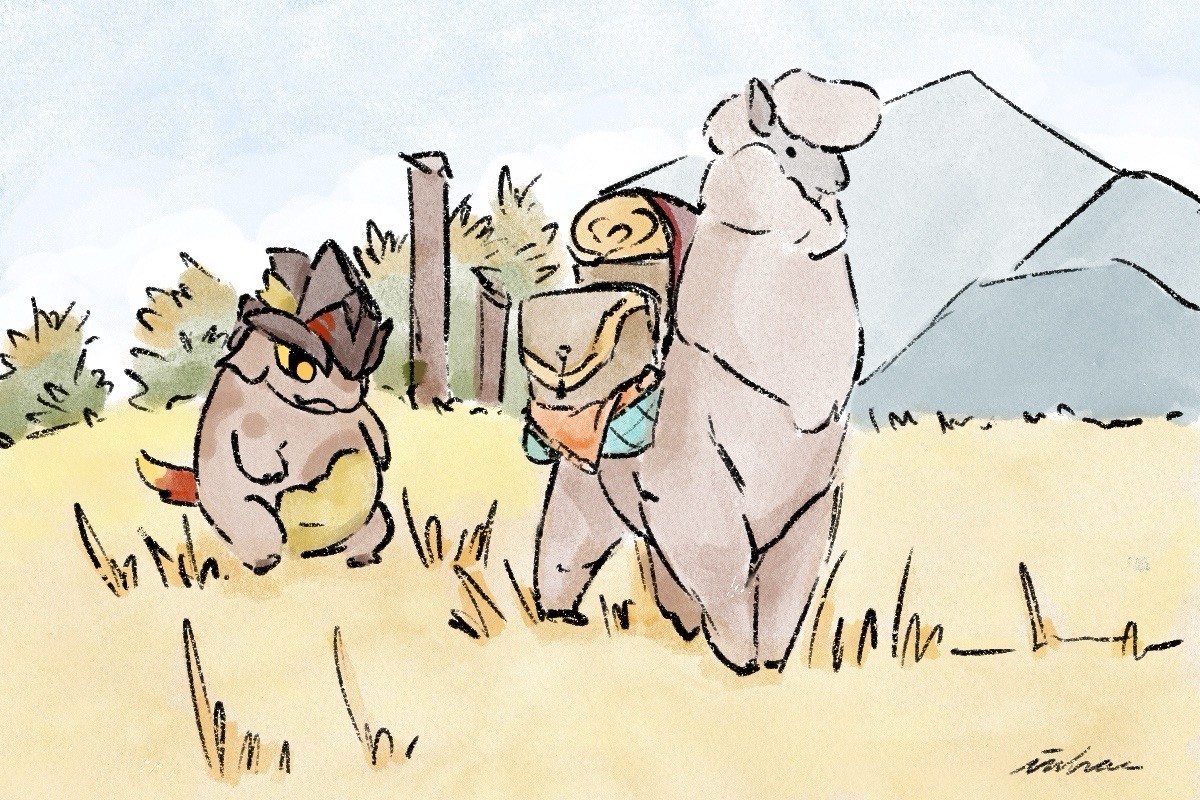
Also, this scene was just too cute not to draw!

A cartoon-style illustration features two animals in a grassy landscape. One is a small, chubby creature that looks like a baby dinosaur, while the other is a large, woolly alpaca carrying supplies on its back. The alpaca is turning its back to the small dinosaur who looks disappointed.
Favourites 1
Inhae @Inhae@social.inhae.blog · 18:14
Genshin DC “Saurian vs Mountain”

特拉忒 Tèlātè: Tlatem
奇卡 qíkǎ: Tlatem’s Yumkasaur

Tlatem uses 它 to talk about his companion, and similarly to our tepetlisaur, we don’t know if they are male or female.

Overall, this dialogue is super easy. Even with unknown words, it was easy to guess the meaning.
The only difficult part was when Tlatem says that Qika is still weak and cannot:

在悬崖旁边窜来窜去

悬崖 xuányá: overhanging cliff, precipice
窜 cuàn: scurry.

Qika cannot scurry around near the cliffs.

There’s really not much vocab to note, but Tlatem mentioned several persons, and I’m very bad at remembering names, so I’ll note them here:

亚瓦尔 Yàwǎěr: Tatlem calls him Yawaer uncle. He provided advice.
马伊塔 Mǎyītǎ: Tatlem’s friend. He is good at 攀岩 pānyán: rock-climb. Tatlem thinks he can help them arrange a training plan.
洛娅 Luòyá: One of the rare persons who can beat Mayita at climbing.

I’ll try to find them and talk to them. I still haven’t talked to all the NPCs, but so far, I understand them well enough to just enjoy the game without constantly looking up words :blob_grin:

Inhae @Inhae@social.inhae.blog · 17:36
Genshin WQ: “The Case of the Crafting Bench” 1/2: spoilers + long

合成台 héchéng tái: crafting bench

I never really paid attention to it before, but this is the crafting bench line:

地火水风,领我敕命。再造四大,重塑五行
dìhuǒshuǐfēng, lǐng wǒ chìmìng. zàizào sìdà, chóngsù wǔxíng

Earth, fire, water, wind.
Take my command (?) I’m not sure about this one.
Rebuild the four elements (earth, water, fire and wind in Buddhism).
Reconstruct the five elements (metal, wood, water, fire and earth in Chinese philosophy).

Paimon said that the crafting bench sneezed: 打喷嚏 dǎ pēntì.

苏玛克 Sūmǎkè: the woman who wants to use the crafting bench.

Sumake wants to 切磋 qiēcuō: learn from each other by exchanging views. The potion she crafted can help people 调整状态 tiáozhěng zhuàngtài: adjust their condition?

—

What follows was really hard! One character is talking endlessly to explain some lore I’ve never heard about before. A lot of unknown words too. Let’s break it down.

Names:

桑科约克 Sāngkēyuēkè: merchant who sold the potion recipe to Sumake
汉佩克 Hànpèikè: doctor who took care of Sumake
蚱蜢派 zhàměng pài: The Grasshopper Faction
鹰羽派 yīngyǔ pài: The Eagle Feather Faction
话事处 huàshìchù: What is this?? Some kind of council of the factions?

Some vocab:

后勤 hòuqín: logistics
设施 shèshī: facilities, installation
派系 pàixì: faction
循规蹈矩 xúnguīdǎojǔ: to follow the rules inflexibly
分身无术 fēnshēn wúshù: cannot attend to many things at once, impossible to be in two places at the same time.
疏漏 shūlòu: careless omission, oversight
截然不同 jiérán bù tóng: entirely different
尽心尽力 jìnxīnjìnlì: making an all-out effort, to do one’s utmost
心服口服 xīnfúkǒufú: to accept wholeheartedly
唯利是图 wéilìshìtú: to be bent solely on profit
钻营 zuānyíng: toadying for personal gain
不佳 bùjiā: not good
配方 pèifāng: prescription
手脚 shǒujiǎo: trick, action
针对 zhēnduì: to target, to be aimed at
波及 bōjí: to spread to, to involve
抵赖 dǐlài: denial

With so many unknown words, it’s no wonder I didn’t follow this whole explanation. It’s clearer now. What I understand is that Hanpeike belongs to the Faction of the Eagle Feathers. They were responsible for taking care of all the logistics and facilities of the Stadium of the Sacred Flame, which is a great honor. However, fewer and fewer people entered the faction, and the lack of manpower led to inevitable mistakes. So the council (?) decided to hold a competition to decide which faction would take care of the Stadium. The Eagles lost, and the Grasshopers won. While the Eagles were strictly following the rules, the Grasshopers are only interested in profit and personal gain, and they don’t work properly.

Hanpeike says that during the competition, a lot of their members had problems after crafting potions, just like Sumake.

Hanpeike thinks that the Grasshoppers did something to the crafting bench. At first it was to target the Eagles, but it’s now affecting other people.

The end was a bit easier: Hanpeike regrets not having grasped evidence when it was still possible, but with Sumake’s accident, there’s still a chance. And we’re going to help.

The following scenes were easier. In order to collect testimony (证言 zhèngyán) from Eagles member, we had to go through several tests (测试 cèshì). We also meet Tuozan (托赞 tuōzàn), a Grasshopper who helps Hanpeike. Paimon straight tells him he’s a traitor (叛徒 pàntú) lol.

Hanpeike feels responsible for the current state of the Eagle Feathers and uses the expressions 无地自容 wúdì zìróng: nowhere to hide one’s shame.

He also quotes a saying according to which “the truth belongs to the minority”, and he won’t give up on carrying out his beliefs just because he fight the majority. Haha, this passage was quite funny.

And now I have to wait two days…

Favourites 3
Inhae @Inhae@social.inhae.blog · 08:12
Genshin TC “Yupanqui's Turnfire”, chapter 1: “A Mysterious Visitor From Huitztlan”

Children are always easy to understand, so overall, this quest was easy… except for two parts: 1- everything Ajaw says and 2- the legend told by the children.

1- Ajaw

吾 wú: old way of referring to oneself. Ajaw always uses it to say “I, me”
仆从 púcóng: footman, retainer, henchman, lackey. That’s how Ajaw refers to Kinich.
劣 lié: inferior. That’s how Ajaw refers to us, we are Kinich’s “inferior friends”.
窥见 kuījiàn: get a glimpse of
英姿 yīngzī: heroic bearing (of course, refers to Ajaw)
供奉 gòngfèng: to worship, make offerings to, pay tribute to (Ajaw)
伟岸 wěi’àn: imposing, outstanding, gigantic in stature (refers to Ajaw)
嵌 qiàn: to inlay, embed, set
汝等 rǔděng: you people (refers to us)
献上 xiànshàng: to offer respectfully, to present (to Ajaw)
朝拜 cháobài: to worship, to make customary deferences to (Ajaw)
跟班 gēnbān: attendant, servant: that’s how Paimon refers to Ajaw: “Kinich’s servant”.
乃 nǎi: to be
无上 wúshàng: supreme: that’s how Ajaw refers to himself: the supreme dragon.
烈焰 lièyàn: raging flames
至高 zhìgāo: paramount, supremacy
领主 lǐngzhǔ: feudal lord, suzerain, overlord
三拜九叩 sānbài jiǔkòu: 3 bowings and 9 kowtows.
仁慈 réncí: benevolent, charitable

That’s just some Ajaw blabla, I guess he’ll always use the same vocab, so if I learn these words, it will get easier and easier to understand him. The part about kissing his cute pixel foot was pretty funny.

He describes himself as the Supreme Lord of the Nation of the Raging Flames or something like that. I wonder what it’s supposed to be. Maybe we’ll learn more in the future.

Also, I start liking Ajaw quite a bit.

He said that he agreed (应许 yīngxǔ) to respond to his attendant’s (Kinich) plea (祈求 qíqiú: to pray for, ask for favours, plead for) and was investigating the Abyss incident in the region.

爬虫: páchóng: reptile. That’s how Ajaw refers to the Yumkasaur.
侵蚀: qīnshí: to corrode
后裔 hòuyì: descendant
低等: dīděng: inferior: refers to the Yumkasaur.
了断: liǎoduàn: to do away with oneself
蚁 yǐ: ant. Refers to Paimon. Ajaw calls her the “small white flying ant”.

Ajaw says that the mother Yumkasaur has been corroded by the Abyss and attacked the tribe as well as her children before throwing herself from a cliff. He thinks that there’s an Abyss magician nearby and we must be careful if we meet a foreigner.

2- The Turnfire Legend (I looked at the wiki for English names)

回火 huíhuǒ: “Turnfire”.

All Ancient Names originate from a legend. The Ancient Name “Malipo” (马力卜 mǎlìbó) originates from the legend of the Turnfire.

According to the legend, the Turnfire appeared during the period of the Grand Alliance (联盟 liánméng: alliance, union, coalition), and it was used by tyrant (暴君 bàojūn) Och-Kan (奥奇坎 àoqíkǎn) to rule over Natlan and suppress (镇压 zhènyā) people who were against him.

People set on fire would feel a burning pain (灼痛 zhuótòng) in their back, but they would not die immediately, and they cannot look back. If they do, they will be burnt to ashes (烧成灰 shāo chéng huī).

Someone stepped forward bravely (挺身而出 tǐngshēn’érchū), and that’s Yupanqui (尤潘基 yóupānjī), from the Scions of the Canopy.

Yupanqui, Och-Kan and the first Pyro Archon Xbalanque (希巴拉克 xībālākè) were friends. Yupanqui was an ordnance (军械 jūnxiè) officer during the Grand Alliance.
He disapproved of Och-Kan’s cruel regime, stole the Turnfire and threw it at the tyrant’s army. They all burnt to ashes. But upon leaving the city, he heard Och-Kan call him and unexpectedly (鬼使神差 guǐshǐshénchāi: unexpected happenings, doings of ghosts and gods) turned back. All he could see was a burning city and the flames reflected in his eyes pierced through his pupils (瞳孔 tóngkǒng) and consumed him.
The fire that consumed him burnt for 100 days and created a hole in the ley lines and entered the Night Kingdom were it stills burns to this day.

This fire illuminates the path to be reborn, but the dead have to accept its burning flames in order to be purify and return to life.

What follows is very easy, so that’s it for the first chapter study. That’s a lot of lore! I wonder if there’s a book… I haven’t collected many books yet, I’ll need to work on that!

Replies 1
Inhae @Inhae@social.inhae.blog · 08:14
Genshin TC: “Yupanqui’s Turnfire” Chapter 2: “A Hero’s Rite”

特立尼达 Tèlìnídá: Trinidad, Huni’s father.

I’ll only study the lore parts.

A long time ago, the tribe had a traditional ceremony (仪式 yíshì) called The Night of the Turnfire (回火夜 huíhuǒyè) to offer sacrifices (祭祀 jìsì) to their ancestor Burkina (布基纳 bùjīnà) and his companion Kongamato (康加玛托 kāngjiāmǎtuō), a strong Yumkasaur warrior.

They fought the Abyss side by side, but Burkina died and Kongamato got contaminated (污染 wūrǎn) and is fast asleep (沉睡 chénshuì) to this day.

He is the tribe’s glory, but it comes with a price. The Abyss energy within him can easily be stimulated (刺激 cìjī). When this happens, he becomes mad and attacks everything around him.

The Rite is not just to offer sacrifices, but also to clear up the Abyss force within Kongamato so that he remains asleep. With the Abyss attacks more and more frequent, Kongamato’s state also becomes more unstable.

As a result, Trinidad wants to hold an additional (额外 éwài) ceremony, and he needs a flame bearer (游火人 yóu huǒ rén). Kinich should be the one doing it, but he asked for money, which Trinidad does not approve of.

Some vocabulary related to the ceremony:

火把 huǒbǎ: torch
粉 fén: burn
污垢 wūgòu: dirt, filfth
峡 xiá: gorge
隙 xì: crack, crevice
洞穴: dòngxué: cave, cavern
火盆 huǒpén: brazier
祭坛 jìtán: altar
亵渎 xièdú: blaspheme
火种 huǒzhǒng: source of a fire

I feel bad that we’re taking Kinich’s place, it seems wrong to accept without consulting with him first. Oh well, it’s not the first time I disapprove of the Traveller’s actions or choices.

I won’t be studying chapter 3 (Kinich story quest), just enjoy. With all the vocab I’ve looked up for chapter 1 and 2, I’m sure the story quest will be easier.

Inhae @Inhae@social.inhae.blog · 16:04
Genshin DC: Grow Up Quickly, Littl'Un - Chinese study + spoilers.


Overall a relatively easy commission, there’s just a couple of passages that I found difficult.

Characters:
塔莫蕾 Tǎmòlěi
阿基约 Ājīyuē
阿蕾梅 Ālěiméi

We can choose between 观察力 guānchálì (observation) and 耐久力 nàijiǔlì (endurance). I chose the first one.

One thing that I found strange is that Ajiyue says it was not easy to find the training venue. The expression he uses is 好不容易才… which I thought would imply spending time and effort. But didn’t he just come up with it on the spot, like a sudden inspiration?

Another difficult sentence was:

要是不给这孩子一个准话,让她有点事情做,她说不定会一个人跑去部族外瞎鼓捣⋯

准话 zhǔnhuà means “definite message or answer”. I understand it as saying something concrete to a child. Like children need a concrete answer “we’ll do it on a set date” rather than a vague “we’ll do it later”?

As for 瞎鼓捣 xiā gǔdao, I’m not sure. It means to foolishly fiddle with something. I think I get the meaning though, she will try to figure out something on her own.

Apart from that, I added a bunch of vocab to Anki, mostly words related to training, digging and explosives.

Favourites 1