Inhae

@Inhae@social.inhae.blog

This used to be my Genshin-only account, but I won’t be using it anymore.

I’m now posting on my main account only > social.inhae.blog/@blue

Learning
Chinese, Japanese and Korean

690 posts 0 following 45 followers Joined May 18, 2024

Inhae @Inhae@social.inhae.blog · 09:28

Lyney’s C1 is a constellation I wouldn’t mind having (kind of want?), so I can try to get Ororon!

Since 4.4, I’ve been sitting on enough wishes to guarantee both Ganyu and Shenhe. If I had known it’d take another year for them to rerun (at this point, I’m not expecting them before next Lantern Rite), I would have gone for Xianyun’s C2 and maybe weapon (I have her C1).

Inhae @Inhae@social.inhae.blog · 09:39
Sabzeruz Festival: Cyno’s jokes in Chinese

1- Cold pudding.

怎么样?冷不丁吃到一块冷布丁的感觉。

Cyno gives a cold pudding to Paimon and says: how is it to lěngbudīng” eat a “lěngbùdīng”.

The first word is 冷不丁 (lěngbudīng) and means “suddenly, unexpectedly”.
The second one is 冷 (lěng) “cold” + 布丁 (bùdīng) “pudding”.

> How is it? the feeling of unexpectedly eating a cold pudding?

2- Seven petals.

因为…它的花瓣向来只有五片,绝不可能存在「七片』!

Cyno asks why henna berries would never deceive people. That’s because they only have five petals, so there cannot be “qīpiàn”.

It’s written has 七片 (qīpiàn) which means “seven petals” (片 is a measure word used with petals).

But you can also hear it as 欺骗 (qīpiàn) “deceive, cheat”

> Because… they always only have five petals, so there absolutely cannot be seven petals (= deception).

3- Eat salt.

湖里的鲈鱼,它们可从不食「盐」。

I’m not sure about this one :meow_question:

Cyno asks Paimon if she would be confident enough to swear to the bass fish in the lake, adding that the bass fish don’t eat “yán”.

It’s written 盐 (yán) which means “salt”. (食盐 shíyán means “table salt”, but my guess is that it means “to eat salt” here, but I could be wrong.)

It could be replaced with 言 (yán) because “eat one’s word” (食言 shíyán) means “go back on one’s word”.

> The bass fish in the lake, they never eat salt (=do not come back on their word).

4- Hat card (with Wanderer).

你的牌⋯会变成「帽」牌货!

Cyno is relieved that Wanderer (Hat Guy) does not play TCG because otherwise, his card would become a “hat” card (= imitation, forgery)

牌 pái: card.
帽 mào: hat.

冒牌货 màopáihuò means “fake goods, imitation, forgery”. But Cyno replaced the 冒 with 帽 which has the same pronunciation but means “hat”.

> Your card… would become a hat card (=forgery)!

(By the way, Cyno and Wanderer are both very strong in TCG. Cyno overload with Chevreuse is meta, and Wanderer freeze with Mona and Eula has always been one of the strongest decks. I’m always scared when I face them lol, so it’s funny that they have a TCG interaction.)

· edited
Inhae @Inhae@social.inhae.blog · 11:51

In reply to @Inhae

Nevermind, why did I think I could level Dockhand’s Assistant on a Saturday lol.

Inhae @Inhae@social.inhae.blog · 09:36

Today I’m going to level Layla’s Dockhand Assistant.

船坞长剑 chuánwù chángjiàn: dock/shipyard long sword

The wiki gives “zhǎng” as pronunciation for 长, but it hardly makes sense? and “chángjiàn” means “long sword”, which fits perfectly.

Replies 1
Inhae @Inhae@social.inhae.blog · 08:52

In reply to @Inhae

Actually, the thing glowing at the center is called 玉珀 (yùpò) “jade amber”, and it is made out of Cor Lapis which is 石珀 (shípò) “stone amber” in Chinese.

Then the text says that this thing was called 金珀 (jīnpò) “golden amber” because it looks like 琥珀 (hǔpò) “amber”.

What I’m trying to say is that the character 珀 is omnipresent.

Favourites 1
Inhae @Inhae@social.inhae.blog · 08:41

I’m levelling to 90 some weapons that are still at 80 or lower despite me using them. I’ll take this opportunity to learn their Chinese name and add them to Anki.

First one was Baizhu’s Prototype Amber that I did yesterday.

试作金珀 shìzuò jīn pò: portotype golden amber.

“amber” is normally 琥珀 hǔpò.

We know from the description that the thing glowing at the center is not amber, but something made out of Cor Lapis. It is called amber because it looks like it.

Replies 1Favourites 1
Inhae @Inhae@social.inhae.blog · 09:45

I had to review 召集 (zhàojí: to call together, to assemble) in today’s Anki session, and I got the tone of the first character wrong (I thought it was zhāo for some reason).

Then I remembered that Xiao’s voiceline when joining party is 听召而来 tīngzhào ér lái (lit. hear the call and come). I hear it all the time in TCG when I switch to his card. Now I won’t have trouble remembering the correct tone of “zhao” anymore!

I think I should add combat lines to Anki. We hear them all the time, so it’s extra vocab easy to remember.

Inhae @Inhae@social.inhae.blog · 22:02
Genshin Sumeru event: initial dialogue (Chinese vocab)

The first dialogue was very easy, that’s a relief. I hope it continues like this.

I’ll just note some interesting vocab:

留个心眼 liú gè xīnyǎn: to be on the alert, to keep one’s eyes open
打比方 dǎ bǐfang: draw an analogy
说漏嘴 shuō lòu zuǐ: let slip a remark, make a slip of the tongue
冷不丁 lěngbudīng: suddenly, unexpectedly
开小差 kāi xiǎochāi: be absent-minded
偷偷摸摸 tōutōu mōmō: furtively, covertly
一拍即合 yīpāi jíhé: hit it off, fit in readily
生疏 shēngshū: not familiar, out of practice, rusty
承蒙 chéngméng: be accorded a kindness, be granted a favour.

But even without looking up words, I was able to understand everything thanks to the context or by guessing the meaning of unknown words from known hanzi.

They mention Dunyarzad, and I didn’t recognise her name at all because it sounds so different than how I pronounce it… It’s 迪娜泽黛 dínàzédài in Chinese.

I don’t know if I’ll study the dialogues of the event… probably not? I might just note interesting things from time to time.

Boosts 1Favourites 1
Inhae @Inhae@social.inhae.blog · 21:55

In reply to @Inhae

Also saw the word 承蒙 chéngméng, it’s a polite expression meaning “be accorded (a kindness)”. I think it’s the first time I see a word with the character 蒙, which is the character in Paimon’s name: 派蒙 pàiméng.

Boosts 1Favourites 4
Inhae @Inhae@social.inhae.blog · 21:37

I saw the word 空前 (kōngqián) in the Sumeru event, it means “unprecedented”. I’m glad because it’s a word I’ve learned recently, in the AQ. The first time I saw it, it was in a four-character expression: 空前绝后 kōngqián juéhòu “unprecedented and never to be duplicated”.

Replies 1Boosts 1Favourites 4
Inhae @Inhae@social.inhae.blog · 21:17

In reply to @Inhae

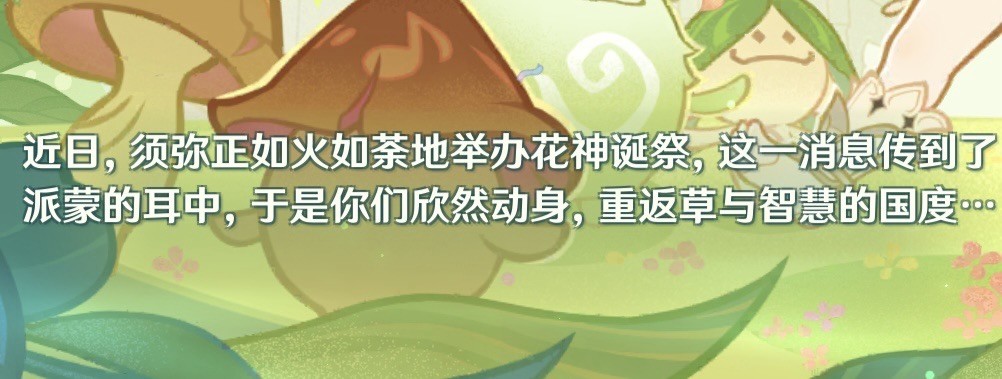
Name of Sabzeruz Festival in Chinese and Sumeru lore.

I learnt that Sabzeruz Festival is 花神诞祭(Huáshén dànjì) in Chinese, it means “Birthday Festival of the Goddess of Flowers”. Interesting to know that the festival is named after her.
Maybe I should read about Sumeru lore before doing the event? I feel like I forgot everything…

Screenshot of an illustration featuring whimsical and colourful mushrooms and text in Chinese reading: 近日,须弥正如火如荼地举办花神诞祭,这一消息传到了派蒙的耳中,于是你们欣然动身,重返草与智慧的国度…
Inhae @Inhae@social.inhae.blog · 21:06

Part of me is tempted to switch back to English for the Sumeru event. Because I did all content related to Sumeru lore in English, I don’t know the equivalent names in Chinese. Vocab will be different too I think, like Natlan has a lot of recurring words, and I’m sure it’s the same for Sumeru, but I never studied them.

I guess I’ll try in Chinese still, I can always check videos in English if it’s really too difficult to understand.

Replies 1
Inhae @Inhae@social.inhae.blog · 15:45

I learnt that “sanctifying elixir” is 祝圣之霜 (zhù shèng zhī shuāng) in Chinese.
Interestingly, 霜 means “frost” not elixir, so the Chinese name would be more like “sanctifying frost”.

Inhae @Inhae@social.inhae.blog · 15:40

Kinich is triple-crowned! 🎉 He’s my third triple crowned character with Xiao and Madam Faruzan.

This and building characters for the IT has used up all my mora. I don’t even have enough to level up artifacts to 4 so that I can feed them to the typewriter. I still haven’t been able to collect 4 sanctifying elixirs to try my luck with a goblet.

The plan:
- farm leylines, get mora
- level up random artifacts to 4
- feed the bad ones to the typewriter
- get my fourth sanctifying elixir and craft a VH anemo goblet.

Favourites 1
Inhae @Inhae@social.inhae.blog · 16:12

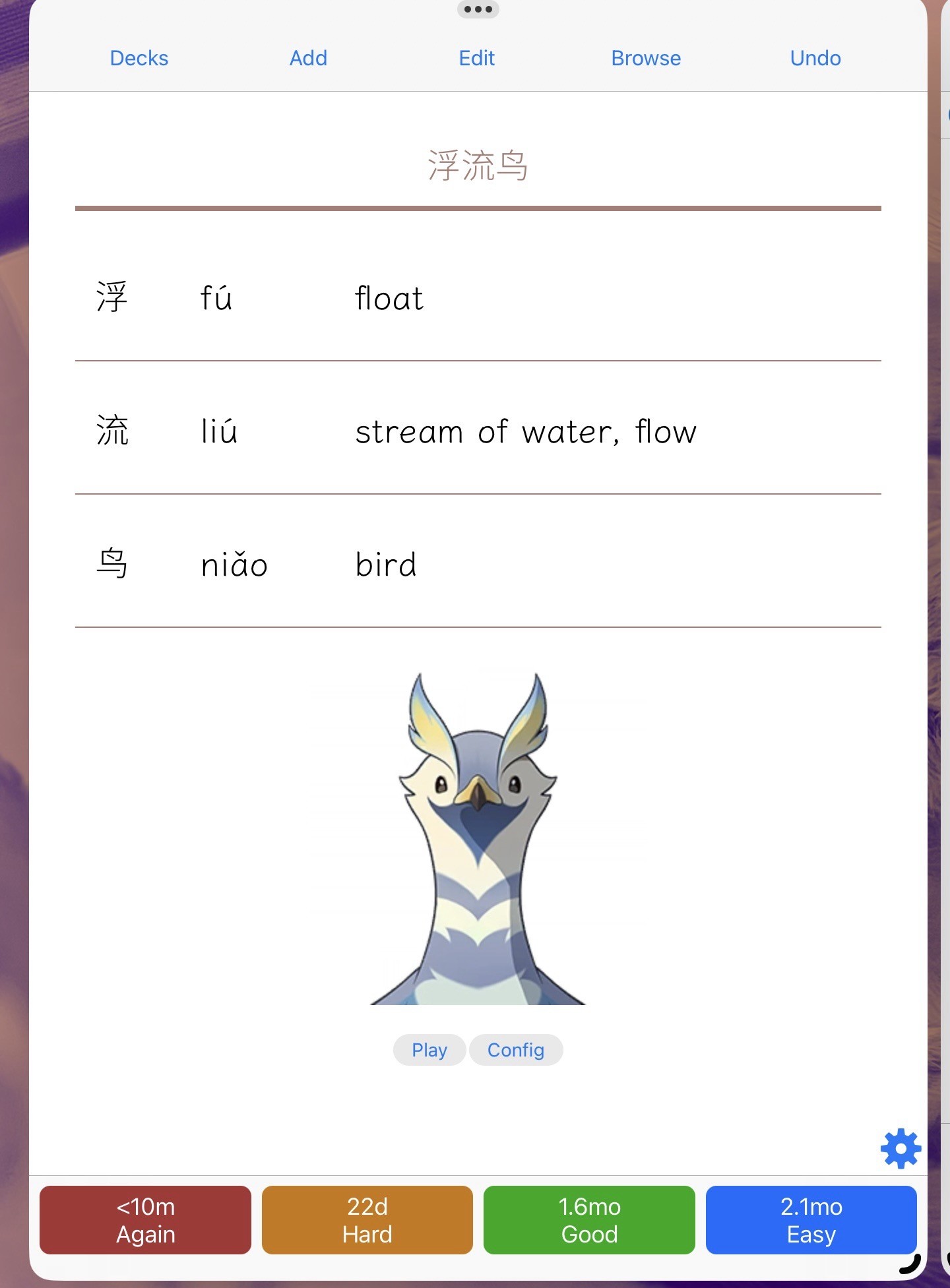
It makes me smile every time this little guy appears in my Anki reviews. See you in 1.6 month!

Screenshot of a flashcard for language learning displaying a three-characters word in Chinese and the meaning and pronunciation of each character. There’s an illustration of a cute bird at the bottom.
Favourites 2
Inhae @Inhae@social.inhae.blog · 16:13

I’ve been watching a Japanese YouTuber on cycling lately, and a couple of days ago I watched a video about cycling on flat road, and so the word 平坦 (へいたん: even, flat) was in the title.

And then today the same word appeared in a daily commission: 平坦 (píngtǎn). Not about cycling obviously (though, nowadays everything is possible!), but still about flat terrain.

Another Chinese word easy to remember thanks to Japanese, I’ll take it!

Favourites 2
Inhae @Inhae@social.inhae.blog · 16:04

In reply to @Inhae

Genshin DC: Grow Up Quickly, Littl'Un - Chinese study + spoilers.


Overall a relatively easy commission, there’s just a couple of passages that I found difficult.

Characters:
塔莫蕾 Tǎmòlěi
阿基约 Ājīyuē
阿蕾梅 Ālěiméi

We can choose between 观察力 guānchálì (observation) and 耐久力 nàijiǔlì (endurance). I chose the first one.

One thing that I found strange is that Ajiyue says it was not easy to find the training venue. The expression he uses is 好不容易才… which I thought would imply spending time and effort. But didn’t he just come up with it on the spot, like a sudden inspiration?

Another difficult sentence was:

要是不给这孩子一个准话,让她有点事情做,她说不定会一个人跑去部族外瞎鼓捣⋯

准话 zhǔnhuà means “definite message or answer”. I understand it as saying something concrete to a child. Like children need a concrete answer “we’ll do it on a set date” rather than a vague “we’ll do it later”?

As for 瞎鼓捣 xiā gǔdao, I’m not sure. It means to foolishly fiddle with something. I think I get the meaning though, she will try to figure out something on her own.

Apart from that, I added a bunch of vocab to Anki, mostly words related to training, digging and explosives.

Favourites 1
Inhae @Inhae@social.inhae.blog · 10:19

I’m working on the Archon Quest vocab, and I learnt the expression:

放鸽子 fàng gēzi: to stand sb up (lit. to release the pigeon).

From what I read, it originates from pigeons being used to send letters, and the story of someone who released a pigeon without the letter.

It’s funny that French also has an animal idiom for the same meaning, “put down (place, lay) a rabbit”.

Favourites 2
Inhae @Inhae@social.inhae.blog · 18:22

I put Kazuha in Kinich’s team because it’s just too funny to go Kazuha skill into “oh, hello Ajaw!”

A character is jumping near a large, pixelated dragon-like green creature with menacing red eyes and glowing blue rays coming out of its mouth.
Favourites 1